Tell us about the job
Takes about a minute. No obligation.
A furnace repair in Lake County starts with the parts that do the most work: the burner, the heat exchanger, and the ignition system. Homes in Lake County, MT run heat about ten months a year, from September through June. By the time a homeowner calls, those components have cycled through cold-weather demand that accumulates wear at a pace a shorter season would not produce. A contractor pulling a furnace apart here checks the heat exchanger for cracks before quoting anything else, because a failed exchanger changes the scope entirely. The ignition system fails quietly, and on a furnace that has seen this much runtime, it is often the first part replaced.
Half the homes in Lake County, Montana were built in 1986 or earlier (2020-2024 ACS 5-year). A furnace sitting in a house that old has often been replaced at least once since the walls went up, and what the opened unit actually contains decides how the repair goes. If the heat exchanger or the control board belongs to a discontinued product line, a contractor sources a substitute or prices a replacement. That is the variable a repair call here turns on, and it shows up after the cabinet is open, not before.
The Parts of a Furnace a Contractor Checks First
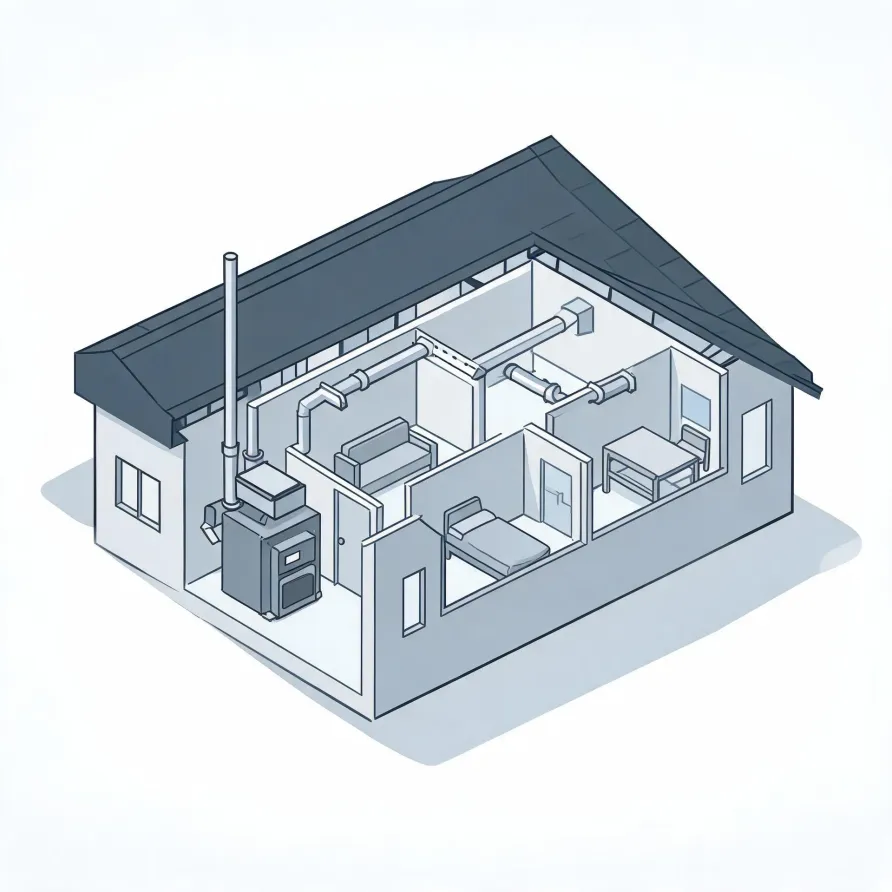
The furnace cabinet sits in the basement, utility room, or closet and holds the components a contractor goes to first when something fails. Inside it, the heat exchanger does the work of warming air, and a cracked or corroded exchanger is one of the more serious faults a contractor will look for. The burners sit just below it, and when a furnace runs poorly or not at all, their condition is an early stop on any diagnostic.
The blower motor and its fan wheel sit at the base of the cabinet and push conditioned air out into the house. A failed motor, a worn capacitor, or a faulty control board can each stop the system in ways that look similar from the outside, so a contractor works through them in sequence. The flue pipe runs from the cabinet up and out of the house, and its condition matters because a blockage or a breach there affects both performance and safety.
The drawing shows a general layout of the system, and a licensed contractor determines which components apply and need attention in your specific home.
Find a contractor in Lake CountyLake County, Montana, by the numbers
195 severe weather events were recorded in Lake County, Montana between 2015 and 2024.
NOAA National Centers for Environmental Information, Storm Events Database, bulk CSV export, events 2015-01-01 through 2024-12-31.Half the homes in Lake County, Montana were built in 1986 or earlier (2020-2024 ACS 5-year).
U.S. Census Bureau, 2020-2024 American Community Survey 5-Year EstimatesLake County, Montana holds 16,468 housing units (2020-2024 ACS 5-year).
U.S. Census Bureau, 2020-2024 American Community Survey 5-Year EstimatesOwners occupy 75.0% of the occupied homes in Lake County, Montana (2020-2024 ACS 5-year).
U.S. Census Bureau, 2020-2024 American Community Survey 5-Year EstimatesCodes & Standards Governing Furnace Repair in Lake County, Montana6 sourced rules and standards
What HVAC Repair Looks Like in Lake County
Non-weatherized gas furnaces manufactured on or after November 19, 2015 must reach 80.0 percent AFUE.
Non-weatherized oil-fired furnaces manufactured on or after November 19, 2015 must reach 83.0 percent AFUE.
Mobile home gas furnaces manufactured on or after November 19, 2015 must reach 80.0 percent AFUE.
Non-weatherized gas furnaces manufactured on or after December 18, 2028 must reach 95.0 percent AFUE, up from the 80.0 percent minimum that applies to units manufactured before that date.
Licensing and Legal Requirements in Lake County, Montana
Montana’s contractor licence does not reach a casual, minor or inconsequential job whose total price for labour, materials and everything else is less than $2,500 — and the exemption is lost if the work is only part of a larger operation, or if a job is divided up to get under the figure.
Montana requires a current construction contractor licence from the Department of Labor and Industry: an individual or business may not engage in business as a construction contractor without one.
Severe Weather Events in Lake County
Extreme weather puts real strain on heating equipment. How hard a furnace has to work, and how often it fails, is tied to local conditions in ways that a national average cannot tell you.
195 severe weather events, 2015–2024. Source: NOAA National Centers for Environmental Information, Storm Events Database.