Tell us about the job
Takes about a minute. No obligation.
Sizing a furnace for this county means sizing it for a system that barely stops running. Homes in Phillips County, MT run heat about nine months a year, from September through May. The burner, the heat exchanger, and the ignition system cycle through that workload with almost no idle time to recover, and a unit that is undersized or poorly sealed at installation accumulates wear at a pace a shorter season would not produce. A contractor quoting a replacement here has to establish the load the house actually puts on the equipment before any equipment decision is sound.
Ductwork laid out for a furnace that is no longer in the house shapes what a contractor finds when a new unit has to connect to it. Half the homes in Phillips County, Montana were built in 1974 or earlier (2020-2024 ACS 5-year). Stock of that age was built around equipment with different output characteristics, and the duct layout reflects those originals, not what a modern furnace delivers. Before any unit gets priced, a contractor has to establish whether the existing trunk lines and branch runs will move air the way the new system needs, or whether they will fight it.
What Gets Installed With a New Furnace
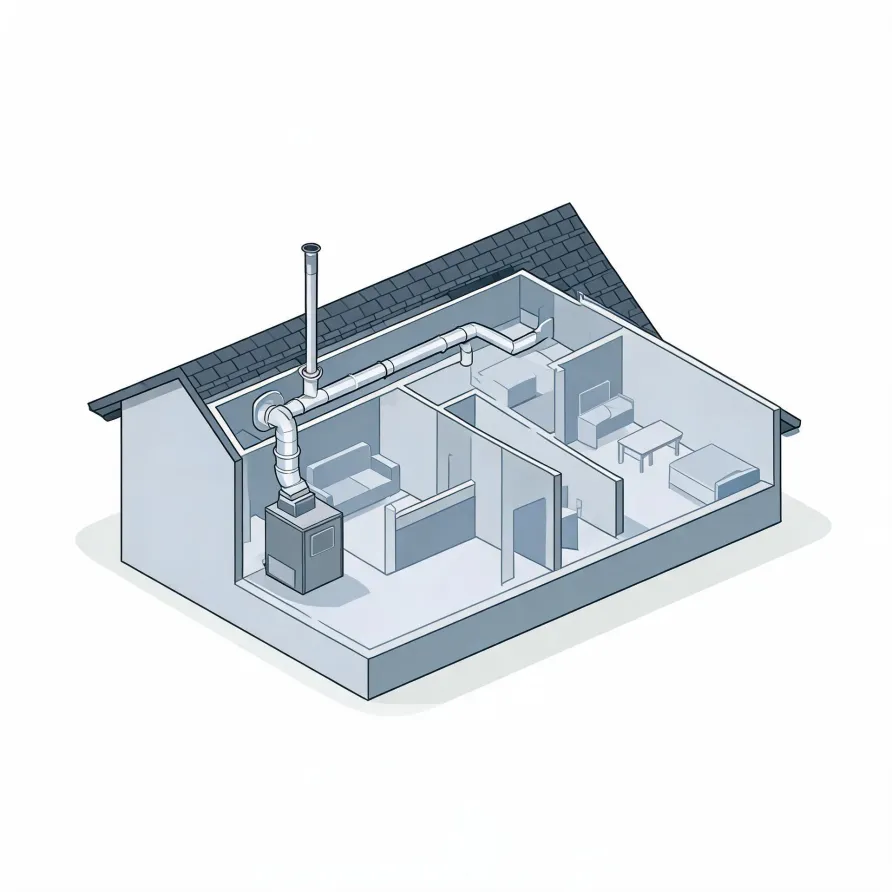
The furnace itself sits in the basement, utility room, or crawlspace and is the unit that produces heat. A heat exchanger inside it warms the air that moves through your home, and a burner assembly below that is where the fuel combustion happens. The flue pipe runs from the furnace up and out of the house, carrying exhaust gases outside.
The air handler and blower sit inside or directly beside the furnace cabinet and push conditioned air into the duct system. A filter housing mounts at the return-air intake, holding the filter that keeps debris out of the equipment. The thermostat goes on an interior wall and is the control point that tells the furnace when to fire.
The drawing shows a typical layout, and a licensed contractor determines exactly which components and configurations apply to your home.
Find a contractor in Phillips CountyPhillips County, MT, by the numbers
319 severe weather events were recorded in Phillips County, Montana between 2015 and 2024.
NOAA National Centers for Environmental Information, Storm Events Database, bulk CSV export, events 2015-01-01 through 2024-12-31.Half the homes in Phillips County, Montana were built in 1974 or earlier (2020-2024 ACS 5-year).
U.S. Census Bureau, 2020-2024 American Community Survey 5-Year EstimatesPhillips County, Montana holds 2,233 housing units (2020-2024 ACS 5-year).
U.S. Census Bureau, 2020-2024 American Community Survey 5-Year EstimatesOwners occupy 73.5% of the occupied homes in Phillips County, Montana (2020-2024 ACS 5-year).
U.S. Census Bureau, 2020-2024 American Community Survey 5-Year EstimatesFurnace Installation Rules for Phillips County, Montana6 sourced standards and codes
What the Installation Looks Like
Non-weatherized gas furnaces manufactured on or after November 19, 2015 must reach 80.0 percent AFUE.
Non-weatherized oil-fired furnaces manufactured on or after November 19, 2015 must reach 83.0 percent AFUE.
Mobile home gas furnaces manufactured on or after November 19, 2015 must reach 80.0 percent AFUE.
Non-weatherized gas furnaces manufactured on or after December 18, 2028 must reach 95.0 percent AFUE, up from the 80.0 percent minimum that applies to units manufactured before that date.
Licensing Rules for Phillips County, Montana
Montana’s contractor licence does not reach a casual, minor or inconsequential job whose total price for labour, materials and everything else is less than $2,500 — and the exemption is lost if the work is only part of a larger operation, or if a job is divided up to get under the figure.
Montana requires a current construction contractor licence from the Department of Labor and Industry: an individual or business may not engage in business as a construction contractor without one.
Severe Weather Events in Phillips County
Phillips County's weather puts real demands on heating equipment. How hard a furnace has to work, and how long it lasts, depends heavily on what the local climate asks of it year after year.
319 severe weather events, 2015–2024. Source: NOAA National Centers for Environmental Information, Storm Events Database.