Tell us about the job
Takes about a minute. No obligation.
Homes in Glacier County, MT run heat in every month of the year. A furnace cycling through every month of the year puts its burner, heat exchanger, and ignition system through repeated stress that a short-season system never accumulates. When a contractor arrives on a repair call here, those parts are where they start: the igniter cracks, the heat exchanger fatigues, and the burner assembly collects residue at a rate that a system with a long idle period simply does not. A contractor who skips straight to the controls or the blower motor without checking combustion components first is working against what the local runtime record predicts.
Furnace repair in housing this old runs straight into a parts availability problem. Half the homes in Glacier County, Montana were built in 1974 or earlier (2020-2024 ACS 5-year). The systems running in those homes are not the ones they were built with, and a contractor opening a furnace has to determine whether the heat exchanger, igniter, or control board it takes is still in production. If a replacement part has gone out of manufacture, the repair either waits on a specialty supplier or the homeowner is looking at a full replacement. That outcome is decided by what the opened unit actually contains, not by anything visible from the outside.
The Parts of a Furnace a Contractor Checks First
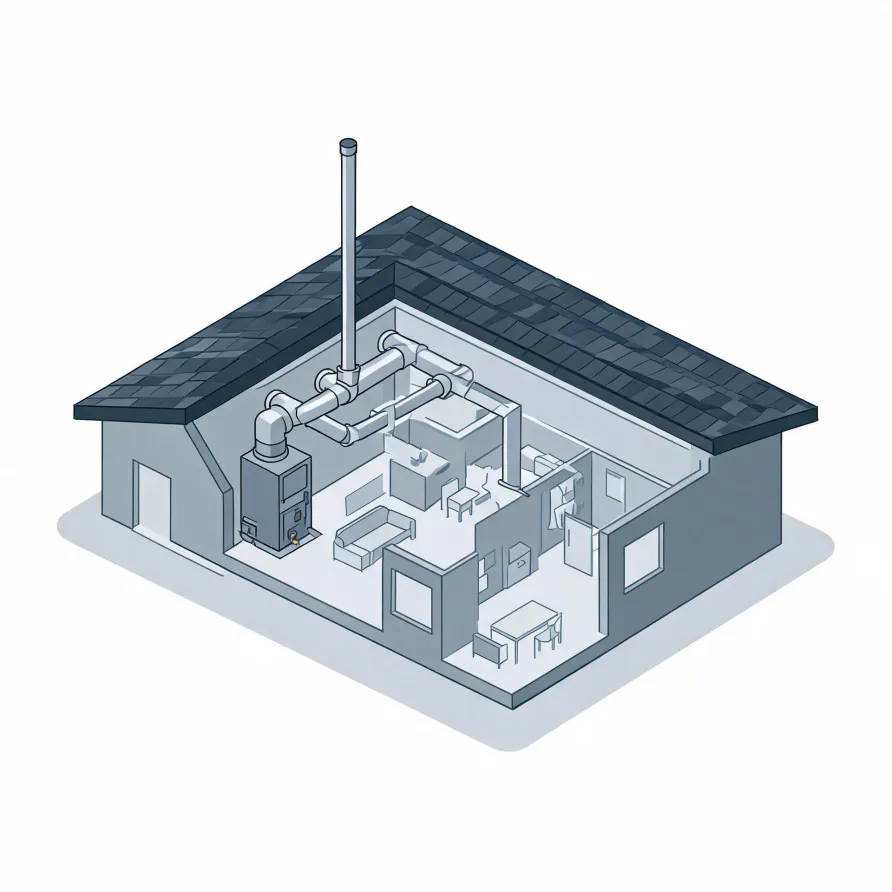
The furnace itself sits in a utility room, basement, or closet and is the heart of the system. Inside it, the heat exchanger is the piece a contractor looks at closely during a repair call. Cracks or failures there let combustion gases into the air supply, so it draws immediate attention. The burners, which sit just below the exchanger, are another early stop.
The blower motor pushes conditioned air out through the supply side of the system and sits inside the furnace cabinet. Near it, the draft inducer pulls exhaust gases out safely before each heating cycle begins. The flue pipe carries those gases out of the house. The thermostat on the wall is the starting point for diagnosing why the system is not responding at all.
The drawing shows a general layout of these components, and a licensed contractor determines what applies to your specific system and home.
Find a contractor in Glacier CountyGlacier County, by the numbers
250 severe weather events were recorded in Glacier County, Montana between 2015 and 2024.
NOAA National Centers for Environmental Information, Storm Events Database, bulk CSV export, events 2015-01-01 through 2024-12-31.Half the homes in Glacier County, Montana were built in 1974 or earlier (2020-2024 ACS 5-year).
U.S. Census Bureau, 2020-2024 American Community Survey 5-Year EstimatesGlacier County, Montana holds 5,350 housing units (2020-2024 ACS 5-year).
U.S. Census Bureau, 2020-2024 American Community Survey 5-Year EstimatesOwners occupy 63.7% of the occupied homes in Glacier County, Montana (2020-2024 ACS 5-year).
U.S. Census Bureau, 2020-2024 American Community Survey 5-Year EstimatesCodes & Standards Governing Furnace Repair in Glacier County, Montana6 sourced rules & standards
What the repair visit looks like
Non-weatherized gas furnaces manufactured on or after November 19, 2015 must reach 80.0 percent AFUE.
Non-weatherized oil-fired furnaces manufactured on or after November 19, 2015 must reach 83.0 percent AFUE.
Mobile home gas furnaces manufactured on or after November 19, 2015 must reach 80.0 percent AFUE.
Non-weatherized gas furnaces manufactured on or after December 18, 2028 must reach 95.0 percent AFUE, up from the 80.0 percent minimum that applies to units manufactured before that date.
Licensing Rules for HVAC Repair in Glacier County, Montana
Montana’s contractor licence does not reach a casual, minor or inconsequential job whose total price for labour, materials and everything else is less than $2,500 — and the exemption is lost if the work is only part of a larger operation, or if a job is divided up to get under the figure.
Montana requires a current construction contractor licence from the Department of Labor and Industry: an individual or business may not engage in business as a construction contractor without one.
Weather Stress on Heating Equipment in Glacier County
Furnaces in Glacier County work against whatever the climate puts out, and that load shapes how hard the equipment runs and how fast wear accumulates. The chart below tracks recorded severe weather events in the county so you can see what local contractors are sizing their repair work against.
250 severe weather events, 2016–2024. Source: NOAA National Centers for Environmental Information, Storm Events Database.