Tell us about the job
Takes about a minute. No obligation.
Sizing a furnace correctly for this house is not a clerical step a contractor does at the end. It decides how hard the burner and heat exchanger cycle every single day of the heating season. Homes in Madison County, MT run heat about eleven months a year, from August through June. A unit running at the wrong capacity works against itself: too small and it runs continuously, too large and it short-cycles, and both patterns drive premature fatigue into the ignition system and heat exchanger. A contractor who pulls a load calculation before quoting is protecting the install from the one failure mode this climate will not let hide.
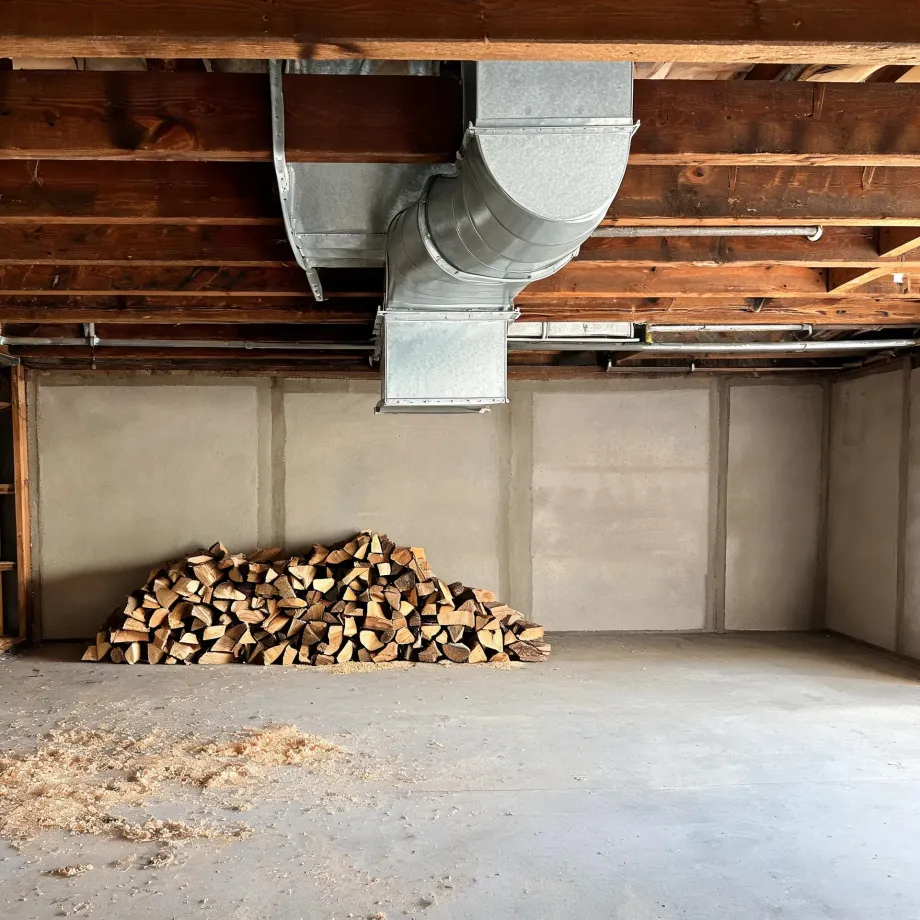
Ductwork laid out for an earlier generation of equipment shapes what a furnace installation actually costs here. Half the homes in Madison County, Montana were built in 1995 or earlier (2020-2024 ACS 5-year). That means a contractor quoting a new furnace has to assess what the existing duct system will carry before the unit itself can be sized. If the runs are undersized or the layout does not match what a modern furnace demands, the ductwork becomes the job, not a footnote to it. The electrical panel gets the same look, since a new furnace draws differently than what the house was originally wired around.
What Gets Installed With a New Furnace
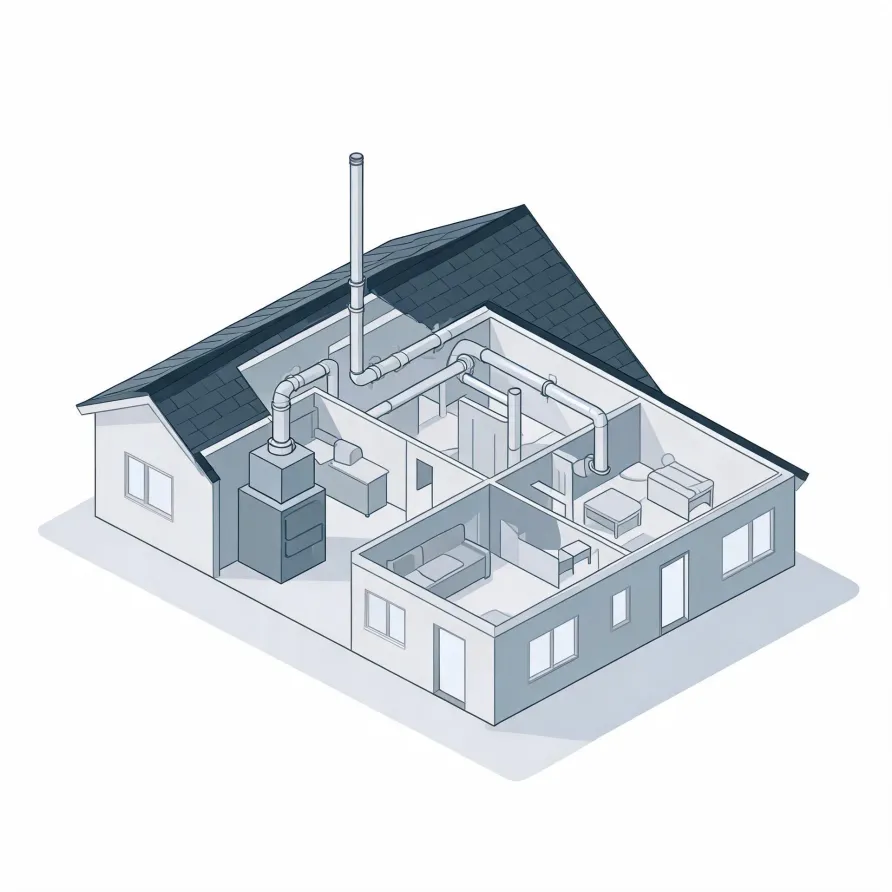
The furnace itself sits in the basement, utility room, or garage and is the unit that generates heat. A heat exchanger lives inside that cabinet, transferring heat to the air that moves through the house. The flue pipe runs from the furnace up and out of the building, carrying combustion exhaust away.
The air handler or blower assembly mounts inside or directly beside the furnace cabinet and pushes conditioned air into the supply side of the system. A thermostat goes on an interior wall and serves as the control point, telling the furnace when to fire and when to stop.
The drawing shows a typical layout, and a licensed contractor determines exactly which components apply to your home.
Find a contractor in Madison CountyMadison County, by the numbers
165 severe weather events were recorded in Madison County, Montana between 2015 and 2024.
NOAA National Centers for Environmental Information, Storm Events Database, bulk CSV export, events 2015-01-01 through 2024-12-31.Half the homes in Madison County, Montana were built in 1995 or earlier (2020-2024 ACS 5-year).
U.S. Census Bureau, 2020-2024 American Community Survey 5-Year EstimatesMadison County, Montana holds 6,396 housing units (2020-2024 ACS 5-year).
U.S. Census Bureau, 2020-2024 American Community Survey 5-Year EstimatesOwners occupy 81.0% of the occupied homes in Madison County, Montana (2020-2024 ACS 5-year).
U.S. Census Bureau, 2020-2024 American Community Survey 5-Year EstimatesFurnace & HVAC Installation Rules for Madison County, Montana6 sourced standards & codes
What the Installation Actually Looks Like
Non-weatherized gas furnaces manufactured on or after November 19, 2015 must reach 80.0 percent AFUE.
Non-weatherized oil-fired furnaces manufactured on or after November 19, 2015 must reach 83.0 percent AFUE.
Mobile home gas furnaces manufactured on or after November 19, 2015 must reach 80.0 percent AFUE.
Non-weatherized gas furnaces manufactured on or after December 18, 2028 must reach 95.0 percent AFUE, up from the 80.0 percent minimum that applies to units manufactured before that date.
Licensing and Legal Requirements in Madison County, Montana
Montana’s contractor licence does not reach a casual, minor or inconsequential job whose total price for labour, materials and everything else is less than $2,500 — and the exemption is lost if the work is only part of a larger operation, or if a job is divided up to get under the figure.
Montana requires a current construction contractor licence from the Department of Labor and Industry: an individual or business may not engage in business as a construction contractor without one.
Severe Weather History in Madison County
Madison County's weather puts real demands on heating equipment, from how hard a furnace has to work to how long its components last. That workload shapes what a contractor specifies at installation.
165 severe weather events, 2015–2024. Source: NOAA National Centers for Environmental Information, Storm Events Database.